Something bugged me about my idea that something could go ~faster~ than the speed of light. If there is one constant in our universe, it's that speed; all energy waves, or 'light', no matter what frequency, travel with the same forward momentum through a vacuum.
This got me to thinking: what would happen if an energy wave's frequency got to a point so high that its lateral movement exceeded its forward motion? Could this energy level be the 'point of creation' of mass? Think about watching a wave on an oscilloscope, then turning the frequency knob to the right: eventually the wave's up and down motion will become indistinguishable from its lateral flow, and the 'wave' will become a solid white (green) bar. Perhaps the 'frequency = speed of light' mass-creating transition point is a bit convenient, but I wouldn't at all be surprised if things were in fact that simple.
This would explain a lot of things, namely the enormous amount of energy contained in atoms (and the enormous amount of energy it takes to fuse or dissemble them). I can also see the beginnings of an explanation of gravity and charge there; could the extreme oscillation of a wave be a source of attraction to others similar to it, and could the 'timing' of the wave explain its 'polarity'? Even this fits in with wave behaviour: opposing waves cancel each other, as do oppositely-charged similar elements such as positrons and electrons. And if indeed a mass-containing object's core energy oscillation is enormous, a 'normal' wave (such as a photon) would indeed affect it but not alter it entirely. Also, could it be that magnetism and gravity are the same thing, and that magnetism is simply an 'amplified gravity' caused by the synchronisation of every core energy wave contained in any magnetic object?
This kind of throws my 'perfect matter' theory into the dustbin, yet it is possible that 'perfect matter' does exist as a simple carrier for energy waves.
Monday, 24 January 2011


Sunday, 23 January 2011
E=mc²: a sum of parts.
Einstein's theory of relativity, E=mc², sums up quite nicely the interoperativity of all elements known to us, but I am persuaded that, in light of the missing 'god particle', they will one day be regrouped into one side of an equation describing the creation and behaviour of mass.
I can sum up all my past blogs on the subject into this: it takes a certain amount of energy, an energy beyond the speed of light, to transform "perfect matter" into a form with mass, or a form visible to us. Any energy short of the speed of light remains just that, energy. This would explain why light has a maximum speed, the existence (and 'weight') of dark matter, and why light can travel through a vacuum: in reality, light (energy), if it is not strong enough to affect the perfect matter, will simply 'surf' through it (like light waves through water, to bring the model down to a lower scale). Light (energy) in our present theories is affected by gravity, but I am persuaded that it is actually 'perfect matter' that is affected by gravity: it is the difference in its density that deviates an energy path, again much like light bends when travelling between air and water.
Energy, or 'charge', has a 'path' - it will travel freely unless blocked by (absorbed by) an object with mass. We know already that it is possible to create elements with a negative charge (or charged with energy on an opposite path), and should opposingly-charged elements meet each other, both will disappear completely. What's left over? I am persuaded that opposingly-charged elements, when meeting, 'trade' their energies and become, once again, perfect matter. I think for this to happen the energies of both elements must be equal in opposing directions.
It would make perfect sense that the beginning of our universe was a huge explosion of energy above the speed of light in all directions (charges); once the mass was created, and the energy of the explosion dropped below mass-creating levels, any energy left over from the explosion would be absorbed by mass-containing elements. The rest is consequential: positively-charged elements would be attracted to negatively-charged elements; if their charges were equally opposed, they would annihilate each other, and if their charges weren't equal, they would bind (in a 'stable' inter-annihilation struggle). It wouldn't surprise me if electrons were simply negatively-charged quarks 'left over' from this initial binding.
The question of charge also brings, once again, dimensions into question.
I can sum up all my past blogs on the subject into this: it takes a certain amount of energy, an energy beyond the speed of light, to transform "perfect matter" into a form with mass, or a form visible to us. Any energy short of the speed of light remains just that, energy. This would explain why light has a maximum speed, the existence (and 'weight') of dark matter, and why light can travel through a vacuum: in reality, light (energy), if it is not strong enough to affect the perfect matter, will simply 'surf' through it (like light waves through water, to bring the model down to a lower scale). Light (energy) in our present theories is affected by gravity, but I am persuaded that it is actually 'perfect matter' that is affected by gravity: it is the difference in its density that deviates an energy path, again much like light bends when travelling between air and water.
Energy, or 'charge', has a 'path' - it will travel freely unless blocked by (absorbed by) an object with mass. We know already that it is possible to create elements with a negative charge (or charged with energy on an opposite path), and should opposingly-charged elements meet each other, both will disappear completely. What's left over? I am persuaded that opposingly-charged elements, when meeting, 'trade' their energies and become, once again, perfect matter. I think for this to happen the energies of both elements must be equal in opposing directions.
It would make perfect sense that the beginning of our universe was a huge explosion of energy above the speed of light in all directions (charges); once the mass was created, and the energy of the explosion dropped below mass-creating levels, any energy left over from the explosion would be absorbed by mass-containing elements. The rest is consequential: positively-charged elements would be attracted to negatively-charged elements; if their charges were equally opposed, they would annihilate each other, and if their charges weren't equal, they would bind (in a 'stable' inter-annihilation struggle). It wouldn't surprise me if electrons were simply negatively-charged quarks 'left over' from this initial binding.
The question of charge also brings, once again, dimensions into question.
Saturday, 22 January 2011
Olbermann's departure from MSNBC: one more Step towards Stupid.
Of course I was surprised and dismayed this morning to hear MSNBC's Keith Olbermann announce that his Friday show would be the last one. I sometimes found him to be a bit over-the-top on some subjects and comments, but he is one of few American journalists remaining today who hold true to the principles of journalism - relating fact-based (not opinion-based) stories in an objective a way as possible. He, like MSNBC's other leading journalists, judged acts at their face value, and only then by their motivations, and would pull no punches for any politician, right or left, if his/her actions were worthy of criticism - and exactly the same in the opposite direction for any action worthy of praise. This is how journalism should be, and Mr. Olbermann is (was?) one of the rational world's last bastions against the immature screeching, whining and lying tactics used by today's political right.
I remember, after George W. Bush's 2004 re-election, an English tabloid headline querying its readers: "Is more than half the U.S. completely stupid?". I don't agree, but I can observe that the more strident and misleading opinions get about just as much airtime as fact, and that the more irrational and extreme the views of a voter, the higher the possibility that he will turn up at the polls. Yet as of today we have one less mainstream figure providing fact to the masses - as fact - and convince them to decide for themselves. Billo, Beck, Rush and Breitbart must be creaming their jeans about now at the thought of a future where even the wildest lies will go uncontested.
The right-wing pundits I mention above, unlike their viewers/listeners, cannot claim the innocence of pure stupidity. At best, they can plead guilty to one of two crimes: they can a) claim purposeful ignorance - ignorance of the true obstacles confronting the majority of the U.S.' population today (already-over-demanding job positions disappearing overseas, lack of even basic health-care for some) because of their already-prosperous position, and promoting other prosperous pundits/politicians/organisations 'like themselves', or b) be corporate-serving corporate-riches-seeking stooges spreading corporate-enriching lies to the very same knowingly-ignorant populace that is enriching the same. Beck and Breitbart are of the latter category - fully aware of their actions and the damages they cause - and in my mind are humans of the most despicable sort - those who wilfully impede and destroy the very essence of what makes us human: fact-(science-)based education and rationality.
Humans think, animals 'feel'. Thinking humans have less tendency to resort to vitriol and violence, a fact that is both true common knowledge and available everywhere, and are less likely to react with the same tactics the same. Yet the trend for today's American public seems to be pundits and politicians, backed by corporations intent on spreading a 'feeling' message to a public remaining dependant upon them because their thoughtless 'feeling' of fear or comfort, behaving in belligerent and irrational manner quite unsuited to a thinking human being. In my mind, watching American politics is like watching a grade-school play-yard: the bullies win out over 'the wimps' in the beginning, but settle down when they are obliged to compete in situations that require rational thought; but what if the U.S.' richest denizens' goal was to create and fund wave after wave of bullies, and make sure the stage was permanently set in a way where no rational thought was 'required' and could never compete? Keith Olbermann was like that big kid a couple grades up who would protect any younger kid he thought 'cool' against gratuitous persecution - and we're going to miss him dearly.
Let's hope Mr. Olbermann finds another post from where he can spread his arguably-over-the-top manner in his unarguably fact-oriented way. I also hope that Mr. Olbermann's departure won't weaken the positions of his co-journalists Ed Schultz, Rachel Maddow and recently-arrived Lawrence O'Donnell, three more rational voices much-needed by the U.S. public today.
I remember, after George W. Bush's 2004 re-election, an English tabloid headline querying its readers: "Is more than half the U.S. completely stupid?". I don't agree, but I can observe that the more strident and misleading opinions get about just as much airtime as fact, and that the more irrational and extreme the views of a voter, the higher the possibility that he will turn up at the polls. Yet as of today we have one less mainstream figure providing fact to the masses - as fact - and convince them to decide for themselves. Billo, Beck, Rush and Breitbart must be creaming their jeans about now at the thought of a future where even the wildest lies will go uncontested.
The right-wing pundits I mention above, unlike their viewers/listeners, cannot claim the innocence of pure stupidity. At best, they can plead guilty to one of two crimes: they can a) claim purposeful ignorance - ignorance of the true obstacles confronting the majority of the U.S.' population today (already-over-demanding job positions disappearing overseas, lack of even basic health-care for some) because of their already-prosperous position, and promoting other prosperous pundits/politicians/organisations 'like themselves', or b) be corporate-serving corporate-riches-seeking stooges spreading corporate-enriching lies to the very same knowingly-ignorant populace that is enriching the same. Beck and Breitbart are of the latter category - fully aware of their actions and the damages they cause - and in my mind are humans of the most despicable sort - those who wilfully impede and destroy the very essence of what makes us human: fact-(science-)based education and rationality.
Humans think, animals 'feel'. Thinking humans have less tendency to resort to vitriol and violence, a fact that is both true common knowledge and available everywhere, and are less likely to react with the same tactics the same. Yet the trend for today's American public seems to be pundits and politicians, backed by corporations intent on spreading a 'feeling' message to a public remaining dependant upon them because their thoughtless 'feeling' of fear or comfort, behaving in belligerent and irrational manner quite unsuited to a thinking human being. In my mind, watching American politics is like watching a grade-school play-yard: the bullies win out over 'the wimps' in the beginning, but settle down when they are obliged to compete in situations that require rational thought; but what if the U.S.' richest denizens' goal was to create and fund wave after wave of bullies, and make sure the stage was permanently set in a way where no rational thought was 'required' and could never compete? Keith Olbermann was like that big kid a couple grades up who would protect any younger kid he thought 'cool' against gratuitous persecution - and we're going to miss him dearly.
Let's hope Mr. Olbermann finds another post from where he can spread his arguably-over-the-top manner in his unarguably fact-oriented way. I also hope that Mr. Olbermann's departure won't weaken the positions of his co-journalists Ed Schultz, Rachel Maddow and recently-arrived Lawrence O'Donnell, three more rational voices much-needed by the U.S. public today.
Thursday, 9 December 2010
The 'Charge Balance' of grouped particles; the Speed of Light
Two questions remain in my mind: how can we explain the charge level, polarity and spin of already-grouped and/or stable fundamental particles (Hadrons and Leptons)? I'd also like to reconsider the 'speed of light'.
For the first question, there seems to be a constant between the spin of Quarks and Leptons - all forms of both have a 1/2 (positive?) spin. Quarks group in threes, and all forms ('volumes') of quark have either a -1/3 or +2/3 charge. Charged Leptons (namely electrons) have a -1 charge. Why this constant? I wouldn't be surprised if, in the beginnings of the universe, there was a large disparity in the charge level of each particle, and that this constant occurred only after quarks grouped into Hadrons; if Hydrogen was indeed the first atom to form in our universe, two positively-charged 'up' quarks bonded with one negatively-charged ('down') quark; once a Hadron was created (if quarks containing opposing but equal charges didn't annihilate each other first), any energy beyond a combined 'level of stability' would be expelled. Consequentially, once the quark bond was complete, the 'binding force' of the stable Hadron would reject a collision with any gamma or beta particles with a charge below a certain energy level. It would be interesting to calculate the total energy contained in all Quarks and Leptons - would they 'balance out' between the negative and positive? In a stable hydrogen atom, containing two +2/3 charged 'up' quarks, one -1/3 charged 'down' quark and one -1 charged electron, the result is zero. In a Helium atom, whose Hadrons (two Protons, two Neutrons) are composed of six 'up' quarks, six 'down' quarks, and two electrons, the result is... zero. Interesting. Or was the math based on the fact?
As a side note, I'm not so sure that this 'charge constant' is so constant: this could explain why atoms towards the bottom of the periodic table are the least stable: a single slight imbalance in a hydrogen atom may not disturb the solidity of its nucleus, but an accumulation of slight imbalances in an atom with a (much) higher atomic number may push its 'energy envelope' (the energy needed for either nuclear fusion or fission) in one direction or another.
My second question concerns the speed of light. This speed has become a constant that is used in many quantum mechanics calculations, but in trying to avoid sounding pompous about it, I'd like to express some doubt about how this number is often used. I know that it is the 'fastest' known speed in the known universe, but what if, instead of treating the travel rate of gamma particles as a 'speed', we treat it as a behaviour: what if the upper extremity of energy known to us was a barrier, an energy level that, if surpassed, would result in a) the absorption of that energy (by some unknown ('perfect state'?) matter) or b) the creation of a new, mass-and-charge-bearing particle? In short, I think that, by using the speed of light to try to discover the 'base states' of quantum physics, we are limiting ourselves - or in other words, hurdling ourselves against a barrier of our own making.
For the first question, there seems to be a constant between the spin of Quarks and Leptons - all forms of both have a 1/2 (positive?) spin. Quarks group in threes, and all forms ('volumes') of quark have either a -1/3 or +2/3 charge. Charged Leptons (namely electrons) have a -1 charge. Why this constant? I wouldn't be surprised if, in the beginnings of the universe, there was a large disparity in the charge level of each particle, and that this constant occurred only after quarks grouped into Hadrons; if Hydrogen was indeed the first atom to form in our universe, two positively-charged 'up' quarks bonded with one negatively-charged ('down') quark; once a Hadron was created (if quarks containing opposing but equal charges didn't annihilate each other first), any energy beyond a combined 'level of stability' would be expelled. Consequentially, once the quark bond was complete, the 'binding force' of the stable Hadron would reject a collision with any gamma or beta particles with a charge below a certain energy level. It would be interesting to calculate the total energy contained in all Quarks and Leptons - would they 'balance out' between the negative and positive? In a stable hydrogen atom, containing two +2/3 charged 'up' quarks, one -1/3 charged 'down' quark and one -1 charged electron, the result is zero. In a Helium atom, whose Hadrons (two Protons, two Neutrons) are composed of six 'up' quarks, six 'down' quarks, and two electrons, the result is... zero. Interesting. Or was the math based on the fact?
As a side note, I'm not so sure that this 'charge constant' is so constant: this could explain why atoms towards the bottom of the periodic table are the least stable: a single slight imbalance in a hydrogen atom may not disturb the solidity of its nucleus, but an accumulation of slight imbalances in an atom with a (much) higher atomic number may push its 'energy envelope' (the energy needed for either nuclear fusion or fission) in one direction or another.
My second question concerns the speed of light. This speed has become a constant that is used in many quantum mechanics calculations, but in trying to avoid sounding pompous about it, I'd like to express some doubt about how this number is often used. I know that it is the 'fastest' known speed in the known universe, but what if, instead of treating the travel rate of gamma particles as a 'speed', we treat it as a behaviour: what if the upper extremity of energy known to us was a barrier, an energy level that, if surpassed, would result in a) the absorption of that energy (by some unknown ('perfect state'?) matter) or b) the creation of a new, mass-and-charge-bearing particle? In short, I think that, by using the speed of light to try to discover the 'base states' of quantum physics, we are limiting ourselves - or in other words, hurdling ourselves against a barrier of our own making.
Tuesday, 7 December 2010
Positive and Negative charge in Particles
I'm still a bit flummoxed over the concept of positive and negative charges in the elementary particles known to us - they seem to maintain a mass-containing 'state'. It's not the elementary particle's qualities themselves that has me thinking, but rather their reaction to each other.
If one takes one of our most basic elementary particles, the quark, one can see that it never remains in an independent state for any length of time, but rather is absorbed by another element, or combines with other 'free' quarks to create a Hadron (Neutron or Proton).
When one examines the grouping of Hadrons, one can see that they either contain two 'up' quarks (+2/3 charge) and one 'down' quark (-1/3 charge) as a Proton, or the opposite (two 'down' quarks and one 'up' quark) as a Neutron. First off, one notices that the higher the charge, the less the mass - Protons have half the mass of Neutrons. Examined individually, we see that the combined charge of each element 'balances' into two different states (a Proton = (+2/3) + (+2/3) + (-1/3) = or a charge of 1; a Neutron = (+2/3) + (-1/3) + (-1/3) = or a charge of 0). The 'binding force' between oppositely-charged quarks is probably generated by each element's effort to annihilate each other, or 'draw' from its neighbouring quark's opposing charge, but lacking the power to do so (the elements must have the same opposing charge to annihilate each other), they simply bind. If the charges of two elementary particles are not equal, I am persuaded that the 'binding force' is generated by the 'overlap' between the charges - the 'up' quark would 'suck' an excess 1/3 charge beyond the charge of a neighbouring 'down' quark, and the -1/3 'down' quark can only 'suck' 1/3 of the charge of a neighbouring 'up' quark (if the two could annihilate each other, a +1/3 charge quark (inexistent in our universe) and a -1/3 quark ('down' quark) would remain). So two 'similar' quarks are in an eternal inter-annihilation battle, but it takes three to attain the balanced 'states' we know as Neutrons and Protons.
Moving one step further, a positively-charged Proton (+1 charge) attracts a negatively-charged electron (-1 charge), which would result in an atom (hydrogen) that has a 0 charge through the sum of its parts. The most common Helium atom (2 protons, 2 neutrons, 2 electrons) would have a sum charge of 0 also (six 'up' quarks, six 'down' quarks, two electrons). The most stable form of Lithium atom (7L) has 3 protons, 4 neutrons, and 3 electrons resulting in an overall charge of 0... but it is in itself an unstable element (because of the ten 'up' quarks (+6 2/3 charge) fighting 11 'down' quarks (-3 2/3 charge))? It would be interesting to follow this up the periodic table.
Questions remaining: above I have reflected upon the behaviour of the most common quark 'flavours', but there exist quarks with higher mass than 'up' and 'down' quarks: 'charm' and 'top' quarks are identical to 'up' quarks in their charge and spin, but they have much greater mass - could this be a difference in the volume of 'neutral state matter' affected by a charge? Also, what of the 'spin' of elementary particles? All save Bosons (energies - eg. Photons) have spin. Could it be possible that a spin put on 'neutral state matter' is enough to transform it into a different (but 'neutral charge') discernible element (a neutrino) having some mass?
The constant I see through all the above is a 'state of balance' - elementary particles of all sorts seem be trying to attain a 'level of zero' state (with or without charge). Only elements with opposing factors can annihilate each other (the opposing 'spins' of neutrinos/antineutrinos cancel each other, the opposing charge of hydrogen and anti-hydrogen atoms cancel each other (leaving neutrinos, if their spin is in the same direction?)).
If one takes one of our most basic elementary particles, the quark, one can see that it never remains in an independent state for any length of time, but rather is absorbed by another element, or combines with other 'free' quarks to create a Hadron (Neutron or Proton).
When one examines the grouping of Hadrons, one can see that they either contain two 'up' quarks (+2/3 charge) and one 'down' quark (-1/3 charge) as a Proton, or the opposite (two 'down' quarks and one 'up' quark) as a Neutron. First off, one notices that the higher the charge, the less the mass - Protons have half the mass of Neutrons. Examined individually, we see that the combined charge of each element 'balances' into two different states (a Proton = (+2/3) + (+2/3) + (-1/3) = or a charge of 1; a Neutron = (+2/3) + (-1/3) + (-1/3) = or a charge of 0). The 'binding force' between oppositely-charged quarks is probably generated by each element's effort to annihilate each other, or 'draw' from its neighbouring quark's opposing charge, but lacking the power to do so (the elements must have the same opposing charge to annihilate each other), they simply bind. If the charges of two elementary particles are not equal, I am persuaded that the 'binding force' is generated by the 'overlap' between the charges - the 'up' quark would 'suck' an excess 1/3 charge beyond the charge of a neighbouring 'down' quark, and the -1/3 'down' quark can only 'suck' 1/3 of the charge of a neighbouring 'up' quark (if the two could annihilate each other, a +1/3 charge quark (inexistent in our universe) and a -1/3 quark ('down' quark) would remain). So two 'similar' quarks are in an eternal inter-annihilation battle, but it takes three to attain the balanced 'states' we know as Neutrons and Protons.
Moving one step further, a positively-charged Proton (+1 charge) attracts a negatively-charged electron (-1 charge), which would result in an atom (hydrogen) that has a 0 charge through the sum of its parts. The most common Helium atom (2 protons, 2 neutrons, 2 electrons) would have a sum charge of 0 also (six 'up' quarks, six 'down' quarks, two electrons). The most stable form of Lithium atom (7L) has 3 protons, 4 neutrons, and 3 electrons resulting in an overall charge of 0... but it is in itself an unstable element (because of the ten 'up' quarks (+6 2/3 charge) fighting 11 'down' quarks (-3 2/3 charge))? It would be interesting to follow this up the periodic table.
Questions remaining: above I have reflected upon the behaviour of the most common quark 'flavours', but there exist quarks with higher mass than 'up' and 'down' quarks: 'charm' and 'top' quarks are identical to 'up' quarks in their charge and spin, but they have much greater mass - could this be a difference in the volume of 'neutral state matter' affected by a charge? Also, what of the 'spin' of elementary particles? All save Bosons (energies - eg. Photons) have spin. Could it be possible that a spin put on 'neutral state matter' is enough to transform it into a different (but 'neutral charge') discernible element (a neutrino) having some mass?
The constant I see through all the above is a 'state of balance' - elementary particles of all sorts seem be trying to attain a 'level of zero' state (with or without charge). Only elements with opposing factors can annihilate each other (the opposing 'spins' of neutrinos/antineutrinos cancel each other, the opposing charge of hydrogen and anti-hydrogen atoms cancel each other (leaving neutrinos, if their spin is in the same direction?)).
Friday, 3 December 2010
Nothing is Something.
Further study into atomic behaviour motivates me to add to my earlier mullings a bit. Yet I am still persuaded that our universe is based on some sort of 'neutral state' material that, thus far, is invisible to us, a matter that may be in itself define 'invisibility'.
What got me thinking the most was my reading on 'antiparticles' - 'stable' particles (any particle in the atomic scale) that operate on a negative charge. In a 'normal' (positively-charged) atom, the positively-charged nucleus (consisting of neutrally-charged neutrons and positively-charged protons) attracts the negatively-charged electron, yet the energy of the electron is not enough to overcome the nucleus' 'binding force' and is repelled by it. The same laws hold true if an atom's nucleus and electron(s) are both negatively-charged. Yet when a particle and its polar-twin antiparticle (say, a hydrogen atom and a 'anti-hydrogen' atom) enter into contact, they annihilate each other, and the same would happen if a positron (positively-charged electron) and electron converge; I am persuaded that whatever is 'left over' from these collisions would be 'neutral state' matter.
Whatever this 'neutral state matter' is, it is capable of accepting a charge, but the conditions in which this could happen would have to be extreme. I imagine an effect almost like water skipping off a duck's back; a ducks's feathers have waterproofing enough to resist absorbing the water propelled on them under 'natural' conditions, but were the water propelled with enough energy (and/or volume), the feathers would be obliged to absorb moisture. This action could explain the behaviour of rays (energy) through a seeming void: if the energy is not travelling with a force/speed enough to affect the 'base state' matter, it will simply skip across it. This may even define the speed of light; any energy above this level is absorbed by the 'base matter', thus becoming invisible to us - or would it create a new perfectly-visible particle?
This model still makes sense when applied to particles as small as quarks. Once a 'base matter' particle becomes charged, it gains mass; it is still 'attracted' back to its 'neutral' state, but is impeded from doing so by its charge. How the newly-formed particle behaves with its neighbouring particles depends on how it is charged: according to today's model, an 'up' quark has a 2/3 charge and a 2.4 MeV mass, and a 'down' quark has a -1/3 charge and twice the mass, and these, once created, would 'clump' into 'stable state' Hadrons (Protons and Neutrons).
I wouldn't be at all surprised if quarks and electrons, if they are not one and the same, are at least in the same family: it would make sense if, at the beginning of the universe, the quark-energy soup combined to form all the Hadrons (Protons and Neutrons) it could, and electrons are simply 'free' negatively-charged quarks 'left over' from this grouping/inter-annihilation: these particles would be attracted to the already-formed Protons by their negative charge, but would lack the energy needed to affect the Proton's already-stable state ('binding energy'), thus gravitate around them.
Atomic construction from then on was consequential, through methods already well-known to us.
Monday, 1 November 2010
Further thought on atom construction.
In examining a chart of known elementary particles (one is available here), I noticed that the lower the electrical charge of an element, the higher the mass. In referring to my earlier thoughts, could this mean that mass can be synonymous to... gravitational pull, and that electrical charge can cancel that pull? Or does it mean that, in order for a certain particle to remain stable, it must contain a 'balanced' charge/base energy ratio?
It seems to fit. An 'up' quark is half as heavy as a 'down' quark, and there is a 'one part' charge difference between the two (an 'up' quark has a 2/3 charge, a 'down' quark has -1/3 - thoughts on this scale later). There are other 'heavier' types of quarks (following the same 2/3 -1/3 pattern), but we'll stick to the base elementary particles for now for simplicity's sake. Anyhow, in the next stage of atomic construction, that is to say the formation of hadrons, we see that quarks whose masses are similar are more prone to group into a stable hadron (proton or neutron). If we then consider electrons, elementary particles having a -1 charge and having approximately 1/5 the mass of an 'up' quark (thus 1/10 of a 'down' quark)... there's something going on here.
I'm imagining something like this:

It seems to fit. An 'up' quark is half as heavy as a 'down' quark, and there is a 'one part' charge difference between the two (an 'up' quark has a 2/3 charge, a 'down' quark has -1/3 - thoughts on this scale later). There are other 'heavier' types of quarks (following the same 2/3 -1/3 pattern), but we'll stick to the base elementary particles for now for simplicity's sake. Anyhow, in the next stage of atomic construction, that is to say the formation of hadrons, we see that quarks whose masses are similar are more prone to group into a stable hadron (proton or neutron). If we then consider electrons, elementary particles having a -1 charge and having approximately 1/5 the mass of an 'up' quark (thus 1/10 of a 'down' quark)... there's something going on here.
I'm imagining something like this:

Of course, the quarks are not to scale (it is possible that the 'G' base energy is consistent, and only the 'E' (charge) element varies), but you get the picture. If we were to bump the electron's -1 charge indicated in the chart above to '0', and apply the same change throughout, it would fit this schema exactly: electrons would have no charge, 'down' quarks would have some charge, but 'up' quarks would have more. In fact, I would in fact like to do away with the notion of 'negative charge' altogether - either something has charge, or it doesn't. Gravitational energy ('base energy') attracts charge energy (they almost seem to be trying to cancel each other out). If it were really that simple...
If we move up to the next stage of atom formation (the grouping of 'like' quarks into hadrons, or neutrons and protons), it makes even more sense: quarks will group according to their charge (two ups and one down, or vice versa - I suppose any additional quark will cause 'imbalance' and be rejected), then neutrons and protons will group in turn (in a stable atom, at least to the lower end of the periodic table, there is an equal amount of neutrons and protons) - in any atom nucleus, it would seem that the energetic charge of protons cancels out those of neutrons, leaving only the gravitational force to hold sway over neighbouring elements (apart from their own attraction, depending on their charge, to the stabalised core).
But let us not forget that the first atoms of our universe were hydrogen atoms - and these have no neutron - yet we can see why a non-charged element (electron) would be attracted to a charged element (proton) only. Let us also remember that an electron penetrating a proton will transform it into a neutron - or, in another way of looking at it, it will transform one of the proton's 'up' quarks into a 'down' one. Yet both of these tendencies still fit into the model - atoms heavier than hydrogen are created through fusion, thus neutrons as well. I doubt that, in its very very atomic beginning, our universe contained anything but hydrogen atoms, energy, and free electrons.
I'd almost like to imagine that the very beginnings of our universe was lumps of 'G matter' and the pure energy ('E') that resulted in/resulted from its release (from its 'perfect state') - I think that every atom that could ever form (through 'quark binding') in our universe already has, and everything else (photons, free electrons), is the 'leftovers' from this initial mix.
On Atom Construction
I wouldn't be surprised if quarks and leptons (electrons) contained the same base element. If, at the beginning of our universe, a soup of base elements separated from their stabilising energy charge tried to return to their original 'perfect' state, it would make sense that these elements would 'bind' according to their energy level. Already-charged (positive) elements would bind with lesser-charged (negative) others, creating hadrons, and these in turn would group according to their own respective 'polarisation' (charge). Already stable hadrons would reject any further binding (each contain three quarks, two 'up' and one 'down', or vice versa) - I wouldn't at all be surprised that electrons (leptons) were unbound but charged quarks ('base elements') 'left over' from the initial 'soup construction' stage, once it was completed. Electrons still attempt to bind with an atom's nucleus (and its protons and neutrons), but the 'rejecting force' ('binding energy') of an atom's nucleus (and its individual hadrons) and its opposing charge, prevent them from doing so.
This fits in with the thought that gravity is the 'base element' minus its initial energy, or the effect caused by the 'base element' trying to capture energy enough to return to its initial 'perfect' state. A base element trying to recuperate its initial energy either succeeds or fails depending on its energy level in relation with its neighbours - once no further hadron binding was possible, everything else that followed (atom construction) was but consequential.
Addendum: I can't help but observe that the 'binding force' between stable elements decreases as we advance further along the atomic construction scale. Binding between quarks (creating hadrons) seems to be the strongest, but it is lower between charged hadrons (neutrons and protons).
I also can't help but notice that protons (containing two charged, or 'up' quarks) alone, unbound, are the only element that can retain stability; neutrons are overcome, or are 'evaporated', by their own forces. Does this mean that a stabilised hadron has to 'feed on' (or be 'fed upon') by its neighbour in order to maintain stability? Neutrons contain one 'charged' quark (or 'up' quark) and two 'down' quarks; although a neutron has greater mass (?), the single 'up' quark (that seems to be the instigator of the binding energy) alone doesn't seem to contain energy enough to keep the quark formation together. It would seem logical that a neutron needs to 'feed' on a proton's two 'up' quarks; together, a proton and a neutron together contain three 'up' quarks and three 'down', thus balance each other perfectly. Furthermore, consider that when a 'negatively charged' electron, when introduced into a proton, creates a neutron: it would seem that a 'negative' (no energy?) electron 'saps' a proton's positive energy (transforming one of its quarks into a higher mass 'down' quark. This seems to fit into the theory that even a quark has a 'stable state' of its own: either it is a 'base energy' (gravitational force) containing no 'electrical' charge, or it is an (equal?) balance of base energy and charged energy. 'Base energy' seems to be the most stable of the two, if a hadron's charged energy is released with the introduction of additional uncharged 'base energy'. This is all beginning to make sense.

This fits in with the thought that gravity is the 'base element' minus its initial energy, or the effect caused by the 'base element' trying to capture energy enough to return to its initial 'perfect' state. A base element trying to recuperate its initial energy either succeeds or fails depending on its energy level in relation with its neighbours - once no further hadron binding was possible, everything else that followed (atom construction) was but consequential.
Addendum: I can't help but observe that the 'binding force' between stable elements decreases as we advance further along the atomic construction scale. Binding between quarks (creating hadrons) seems to be the strongest, but it is lower between charged hadrons (neutrons and protons).
I also can't help but notice that protons (containing two charged, or 'up' quarks) alone, unbound, are the only element that can retain stability; neutrons are overcome, or are 'evaporated', by their own forces. Does this mean that a stabilised hadron has to 'feed on' (or be 'fed upon') by its neighbour in order to maintain stability? Neutrons contain one 'charged' quark (or 'up' quark) and two 'down' quarks; although a neutron has greater mass (?), the single 'up' quark (that seems to be the instigator of the binding energy) alone doesn't seem to contain energy enough to keep the quark formation together. It would seem logical that a neutron needs to 'feed' on a proton's two 'up' quarks; together, a proton and a neutron together contain three 'up' quarks and three 'down', thus balance each other perfectly. Furthermore, consider that when a 'negatively charged' electron, when introduced into a proton, creates a neutron: it would seem that a 'negative' (no energy?) electron 'saps' a proton's positive energy (transforming one of its quarks into a higher mass 'down' quark. This seems to fit into the theory that even a quark has a 'stable state' of its own: either it is a 'base energy' (gravitational force) containing no 'electrical' charge, or it is an (equal?) balance of base energy and charged energy. 'Base energy' seems to be the most stable of the two, if a hadron's charged energy is released with the introduction of additional uncharged 'base energy'. This is all beginning to make sense.

Monday, 25 October 2010
A difference in state: Mass and Dark Matter.
In my earlier posts and illustrations, I tried to portray the interaction of objects with a state of mass against those without: I don't think I was very clear, and I am thinking now that I may have been off the mark. I tried to attribute gravity to the effect between 'perfect state' and 'altered state' matter, but I'm beginning to change my mind and think that, although there may be some inter-reaction between those states, their respective behaviours are not interdependent.
I like more and more the idea that our universe is a soup of a) Perfect energy (dark matter); b) 'altered state' matter, or 'perfect energy' that has somehow been stripped of a stabilising element thus giving it a gravitational quality, and c) energy - or the energy needed for that 'altered state' matter to return to its 'perfect state' form.
Gravity may just be an instability, the result of a 'perfect state' being divorced from the energy it needs to maintain that 'perfect' form. I almost got it right in my earlier illustration showing a 'perfect state' as three (why three, I don't know) objects, one of which is energy; I could in fact simplify it like so:

I like more and more the idea that our universe is a soup of a) Perfect energy (dark matter); b) 'altered state' matter, or 'perfect energy' that has somehow been stripped of a stabilising element thus giving it a gravitational quality, and c) energy - or the energy needed for that 'altered state' matter to return to its 'perfect state' form.
Gravity may just be an instability, the result of a 'perfect state' being divorced from the energy it needs to maintain that 'perfect' form. I almost got it right in my earlier illustration showing a 'perfect state' as three (why three, I don't know) objects, one of which is energy; I could in fact simplify it like so:

This would explain many things. I can easily imagine that the beginning of our universe was nothing but a soup of 'base elements' (G) and energy (E) left over from a cataclysmic disturbance great enough to separate them: If our laws of physics remain true (see 'Nuclear Fusion'), the energy needed for that soup to return to its original state would be enormous; it is even possible that our universe does not contain enough energy for that event to ever occur. Thus, in the presence of an enormous amount of energy, but not enough energy to return to their original form, the base elements of our universe recuperated what energy they could, and in regrouping according to their energy content and number of 'base elements', formed what became the hydrogen atoms that were the origin of everything 'solid' in the universe we know today.
I can try to extend this theory to the formation of atoms themselves: it would seem reasonable that 'base energy' elements that have recuperated some of their former energy potential would bond with others that haven't: this would follow the behaviour of quarks that form, always in three, neutrons and protons. Electrons could have formed at the very beginning of the big bang, as 'base energy' elements that had achieved stability through their negative charge (no charge?), but it is also possible that they are the result of a secondary cataclysm caused by the first fusion of (electron-less) hydrogen nuclei. Everything else is a spectrum of 'free energy'.
Vacuum == 'Dark matter'?
The behaviour/existence of photons is still a mystery to many in the scientific world today. Is a photon a particle, and does it have mass? It is proven that a photon can contribute/subtract mass to/from an atom or atomic structure, but this phenomena is attributed to the photon's energy content; energy added to an existing mass increases that mass without adding any additional material content. The speed of light is calculated on the rate at which a photon travels through a vacuum - or its rate of travel through space containing no discernible obstacle.
This never ceases to puzzle me. Why, when we observe the behaviour of energy in more 'material' objects, should the rules change when the 'energy carrier' decreases in density? Objects made up of 'loosely' tied atoms absorb energy because of the volume of 'free electrons' they contain, and objects of densely packed atoms (namely crystalline structures) let light pass because they have few energy-absorbing free electrons; crystalline structures are in fact photon carriers.
When we observe the behaviour of light through crystalline structures, namely lenses, we can see that they can 'bend' light depending on their form. Light passing through lenses in fact not 'bent', but deflected: light exiting a crystalline structure will do so in a direction away from the thickest part of the lens, or the part of the lens containing the most speed-reducing atoms.
Doesn't the vacuum we call space behave in the same way? It is known that gravity can 'bend' light, a phenomena often attributed to the hypothetical gravitational qualities of photons themselves, but what if it was not the photon itself that was being deviated by gravity, but its carrier?
This makes perfect sense to me. Take, for example, light travelling past a black hole: if the gravitational pull is greater towards the centre of the black hole, so is the mass density; light has more density/gravity to go through on its side towards the black hole, so its path until the point where the gravitational pull is strongest, it will be deflected away; once past the gravitational apogee, if the black hole is perfectly spherical, the light will be deflected back towards its original path.

I wouldn't be surprised if gravity has no effect on light at all. If light depended on a 'carrier' that exists even in an environment we consider to be a 'vacuum', we could do away with the 'electromagnetic quality' theories about photons; photons would become a form of energy whose transmission depends on the quality of its carrier, and would behave just like any other energy known to us.
This leads me to believe that there is no such thing as 'nothing'. If the 'vacuum' of space was in fact a sea of inert 'perfect state' matter, or a material that some scientists are beginning to call 'dark matter', this would simplify the spectral map, and behaviour, of our universe's elements enormously.
This never ceases to puzzle me. Why, when we observe the behaviour of energy in more 'material' objects, should the rules change when the 'energy carrier' decreases in density? Objects made up of 'loosely' tied atoms absorb energy because of the volume of 'free electrons' they contain, and objects of densely packed atoms (namely crystalline structures) let light pass because they have few energy-absorbing free electrons; crystalline structures are in fact photon carriers.
When we observe the behaviour of light through crystalline structures, namely lenses, we can see that they can 'bend' light depending on their form. Light passing through lenses in fact not 'bent', but deflected: light exiting a crystalline structure will do so in a direction away from the thickest part of the lens, or the part of the lens containing the most speed-reducing atoms.
Doesn't the vacuum we call space behave in the same way? It is known that gravity can 'bend' light, a phenomena often attributed to the hypothetical gravitational qualities of photons themselves, but what if it was not the photon itself that was being deviated by gravity, but its carrier?
This makes perfect sense to me. Take, for example, light travelling past a black hole: if the gravitational pull is greater towards the centre of the black hole, so is the mass density; light has more density/gravity to go through on its side towards the black hole, so its path until the point where the gravitational pull is strongest, it will be deflected away; once past the gravitational apogee, if the black hole is perfectly spherical, the light will be deflected back towards its original path.
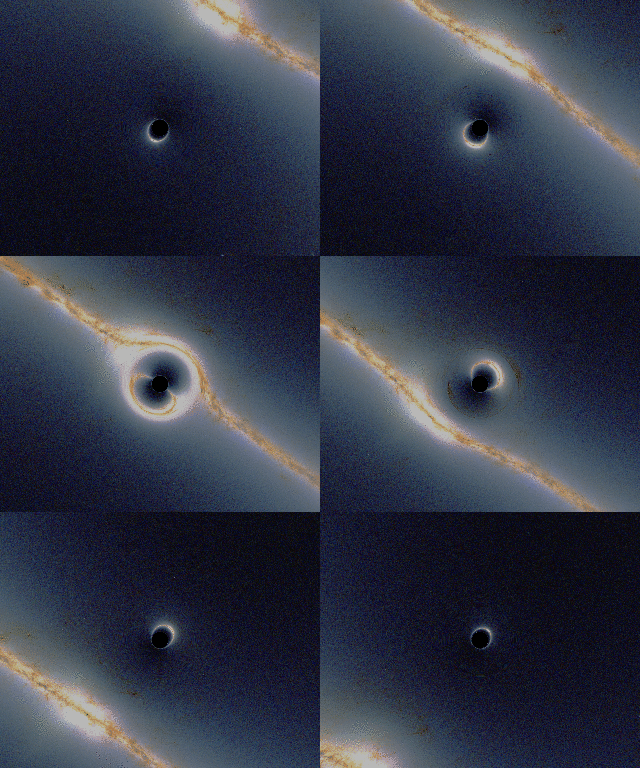
This leads me to believe that there is no such thing as 'nothing'. If the 'vacuum' of space was in fact a sea of inert 'perfect state' matter, or a material that some scientists are beginning to call 'dark matter', this would simplify the spectral map, and behaviour, of our universe's elements enormously.
Sunday, 10 October 2010
The Theory of Everything - In a nutshell.
Okay, a picture is worth a thousand words, so I've created a few diagrams outlining my idea.
Here we have our two states, Base Energy, or the 'foundation' upon all is built, and Reduced Energy, the mass-creating state that is the base of everything we know.


The first diagram seems to indicate direction, but we're talking about states here, so let's simplify things by taking movement out of the equation.

The above diagram describes the present state of my theory - of what is Base Energy composed? I am persuaded that it is at a 'higher' state than the elements visible in our universe. Elements we know closest to the Base Energy state are the 'fastest' (electrons, photons) and have the least gravitational pull - which would move me to think almost of a 'state spectrum' which would look something like this:

I am also persuaded that the 'energy state' difference between quarks and photons is minuscule - but since each state has its own degree of 'glue power', it takes an enormous amount of energy (from our universe) to override the binding force and 'raise' the targeted element's energy level.
It would seem logical that the first element known to our universe was Hydrogen. If the Big Bang was the spewing of an initial 'goo spectrum' of base matter into our universe (dimension), the matter would 'bind' according to its state (energy level) - and the logical result would be our simplest atom, Hydrogen. Everything that happened beyond in our universe is consequential, but these reactions seem to tend towards an 'energy down' direction (elements stripped of all energy save gravity). In order for a base element to 'energy up' to the Base Energy level, something needs to be added to it; without that energy boost, a base element will be prey mainly to the gravitational pull generated by the degree of 'difference of state' between itself and the Base Energy.
Saturday, 9 October 2010
Black Holes - addendum
I'd just like to 'touch up' some thoughts I had about 'mega black holes' - black holes with a mass so great that their cores have (possibly) been reduced to quarks and gluons. If the energy created by the massive compression was so great that quarks (and gluons) would be 'energized' enough to return to their 'perfect state', the black hole would lose mass until it became one with a core of highly compact neutrons. On the other hand, since fusion in elements beyond iron actually needs energy, an energy already consumed by the star during its collapse, I would find it highly plausible that the black hole would stabilize, no matter it's core's consistence.
One conclusion I have been able to confirm through all this is that gravity is the energy pulling an element towards its natural 'perfect' state, and all other forms of quantum-level energy push elements away from that state. In fact, I am even persuaded that there are only two forms of energy working at a quantic level - 'dead' energy (gravity) and 'positive' energy.
One conclusion I have been able to confirm through all this is that gravity is the energy pulling an element towards its natural 'perfect' state, and all other forms of quantum-level energy push elements away from that state. In fact, I am even persuaded that there are only two forms of energy working at a quantic level - 'dead' energy (gravity) and 'positive' energy.
Subscribe to:
Posts (Atom)